A dedicated source of market insights and product developments from the largest network of specialised providers of maritime data and analytics.
The Tonnage Math Behind a Hormuz Reopening 🇮🇷 Too Much of a Good Thing 🚢 Why Russian-Linked Vessels Are Loitering Above European Subsea Cables 🇷🇺
|
Maritimedata.ai is a single source of access to 200+ data services. 200+ Products 60+ Maritime Intelligence Providers 30+ Years of Experience Insights 📈Oil & Gas 🛢️
Dry 🚢
Other 🌎New Data Available - Fuel Oil and Feedstock Flows
The Tonnage Math Behind a Hormuz Reopening - VortexaA Hormuz reopening is unlikely to trigger an immediate VLCC tonnage squeeze, as ample ballast capacity is already positioning towards the MEG, whereas diverting ballasters from the Atlantic could further add to the tally. There has been a lot of discussion on whether a potential Strait of Hormuz reopening could provide a significant upside on freight rates, specifically for VLCCs. Even setting the current baseline to understand from which rates will increase or decline is challenging, as VLCC rates reported west of Hormuz aren't necessarily reliable given the illiquidity of deals. This piece sets out our view on the tonnage and cargo dynamics behind that question, and quantifies the conditions under which Atlantic-bound VLCCs would find it worthwhile to divert back to the Middle East Gulf. From a vessel demand perspective, regional infrastructure is expected to take several months to normalise, while MEG crude inventories (excl. Iran) remain below 5-year seasonal ranges. Cargo enquiries however could carry a wider booking window than usual, which could provide employment support that propagates through to rate uplifts in other regions, such as the Atlantic Basin. To better understand how the situation in the Gulf is likely to unfold, it helps to look at the tonnage picture. Any near-term spike in rates is unlikely to be driven by a shortage of tonnage, at least in the crude segment, and to the extent one occurs, it should be short-lived. Mainstream ballast VLCCs are rushing toward the MEG. VLCCs in the Pacific not currently heading toward the Atlantic Basin are sitting at levels in line with pre-war averages, while the number of VLCCs located in East Asia, though still below 2-year averages, is rising — implying the pool available to load from the MEG should keep expanding over the next two weeks.
Too Much of a Good Thing - GibsonsThe Strait of Hormuz has been largely blocked since late February but despite an unprecedented energy crisis, tanker ordering activity for large carriers has intensified notably this year, especially for VLCCs, the segment that is arguably the most exposed to the extended Hormuz closure. Over 120 VLCCs have been ordered this year, with this number already exceeding the highest annual VLCC order total on record. This adds to already strong investment over the previous two years, taking the VLCC orderbook from around 5% of the existing fleet in early 2024 to 35% today. This ratio is significantly higher when only mainstream vessels are considered, given that one-fifth of the VLCC fleet is already dark/sanctioned. The Suezmax segment has also attracted significant new investment, albeit at a more measured pace than VLCCs. Over 60 tankers have been ordered for the year to date, the second highest since 2015. As with VLCCs, robust investment in Suezmaxes has also been observed in recent years, meaning that this size group has the second highest orderbook, at 30% of the total existing fleet, and much higher if dark/sanctioned ships are excluded from these calculations. Investment in other size groups is lower in comparison to larger sizes; yet again orders for the year to date are also fairly close to total investment seen last year. The orderbook looks much healthier but this is in part a function of a healthy stream of deliveries in 2025 and so far in 2026. At present, MR orders account for 20% of the existing fleet, whilst the Aframax/LR2 orderbook stands at 18%. The Handy and LR1/Panamax orderbook is notably lower but so has been investment in these segments for the past decade (with a few exceptions during the 2023-25 period). There are unquestionably a few solid fundamental reasons for the overall increases in new investment levels, not least the ballooning size of the dark/sanctioned fleet and a rapidly ageing fleet profile, with over 21% of the fleet over 25,000 dwt already at 20 years of age or older and another 28% in the 15 to 19 year bracket. A further driver has been the substantial premiums commanded by modern secondhand tonnage, making newbuildings a more attractive long-term investment. On the demand side, Venezuela’s reset shifted demand into mainstream tonnage overnight, and a US-Iran deal could deliver a similar shift for Iranian crude. Ownership concentration in the VLCC segment has also reached unprecedented levels, which in a tight market has shown the benefits of tactically holding tonnage back. The tanker market’s own strength has also played a role. Yet we have been here before and the question is how much is too much? The answer will evolve over time depending on geopolitical events, the evolution of tanker trade and the pace of removal of ageing and/or dark/sanctioned vessels from trading. High earnings leave little incentive to scrap, but sooner or later that will change: either as chartering restrictions shut older ships out of trading, or as the weight of new deliveries bears down on the market. When that moment comes, demolition capacity could face a serious test given the sheer volume of ageing tonnage.
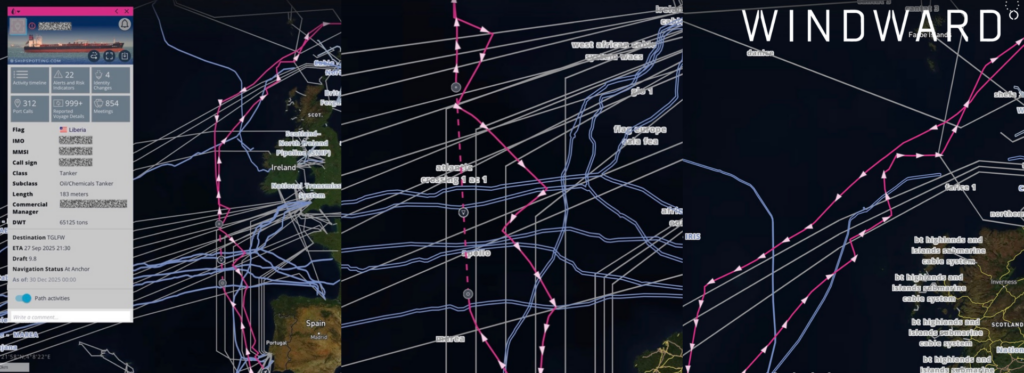
Why Russian-Linked Vessels Are Loitering Above European Subsea Cables - WindwardRussian-flagged and Russian-linked vessels have been observed exhibiting behavior over European subsea cables with no commercial explanation, including zig-zagging, loitering, AIS gaps, and uneconomic routing directly above critical cable infrastructure. Behavior With No Commercial ExplanationThe signature is consistent across multiple vessels in different parts of European waters. A tanker arcs off its expected route. It loiters above a cable system, sometimes for hours, sometimes for days. Its AIS goes dark for long enough to obscure precise positioning but short enough to claim transmission failure. It re-emerges, continues on, and the voyage data shows nothing legally anomalous. In each individual case, the behavior could be explained away as a weather diversion, a mechanical issue, or a signal loss. Examined as isolated events, none of the cases below would necessarily trigger an enforcement response. Examined as a pattern across Russian-flagged and Russian-linked vessels, in proximity to specific critical infrastructure, with similar behavioral signatures, the picture is harder to dismiss. The vessels are operating in European waters that authorities are watching with increasing scrutiny. Since the Nord Stream pipeline sabotage in 2022, NATO has stood up a Critical Undersea Infrastructure Coordination Cell and a dedicated Maritime Centre for the Security of Critical Undersea Infrastructure at Allied Maritime Command. The seabed has emerged as a domain of gray zone aggression between Russia and NATO, and the vessels below are operating in that environment. The CasesAtlantic Cable Zig-Zagging During UK Channel BypassOne document case involved a Cameroon-flagged tanker, one of 12 Russian shadow fleet vessels documented bypassing the English Channel in repeated diversions around Great Britain. Two of those diversions, in February and April 2026, produced a distinctive secondary pattern. While arcing around the outer edge of the UK’s Exclusive Economic Zone, the vessel did not transit its diversion route in a straight commercial line. The vessel zig-zagged over an area of the Atlantic where subsea cables are present.
A tanker with a declared commercial voyage between Russian Baltic ports and a global destination has no commercial reason to deviate from its arc to cross and re-cross specific stretches of open ocean. The vessel did it twice in two months, in the same waters, while its primary voyage purpose was already a sanctions-driven diversion away from coast guard scrutiny. The Atlantic zig-zagging was preceded in January 2026 by a separate AIS gap. The vessel did not transmit AIS for just over 24 hours from January 9 to 10, in the same vicinity, while sailing northbound for Russia. AIS gaps of this duration are frequently operational. A tanker that goes dark for 24 hours above the same waters it will later zig-zag across is unusual.
How we can help:
Thank you for your time. Regards, James Littlejohn Co-Founder Info@maritimedata.ai +44 (0)208 050 9806 You might be receiving this email because we believe that the content of our newsletter may be of interest to you based on your profession. However, if we have made an incorrect assumption, we apologise for any inconvenience caused. If you do not wish to receive future publications, please follow the instructions below to unsubscribe. |

Maritime Data Newsletter
A dedicated source of market insights and product developments from the largest network of specialised providers of maritime data and analytics.
Maritimedata.ai is a single source of access to 200+ data services. 200+ Products 60+ Source data partners 30+ Years of Experience Explore our catalogue Insights 📈 Oil & Gas 🛢️ Structural Checkmate (Link) Strait Tensions Redirect North American Crude Flows (Link) Another Brick In The Wall - Houthi attacks complicate Saudi exports (Link) Dry 🚢 Q2 2026 saw strong growth in soybean and corn flows driven by a record Brazilian harvest (Link) Freight Outlook - 24/07 (Link) China unveiled a...
Maritimedata.ai is a single source of access to 200+ data services. 200+ Products 60+ Maritime Intelligence Providers 30+ Years of Experience Explore our catalogue Insights 📈 Oil & Gas 🛢️ How much of China's crude demand will return? (Link) "El Niño" Declaration Pressures US Crude Export Outlook (Link) Why China’s Crude Collapse Isn’t The Demand Story It Looks Like (Link) Dry 🚢 Q2 Sees Global Met and Thermal Coal Flows Accelerate (Link) Freight Outlook - 10/07 (Link) Frances Maize Crop Drops...
Maritimedata.ai is a single source of access to 200+ data services. 200+ Products 60+ Maritime Intelligence Providers 30+ Years of Experience Explore our catalogue Insights 📈 Oil & Gas 🛢️ Trumping 2025 (Link) Jones Act Vessels For International Crude Trade (Link) Full Steam Ahead? Not So Fast! (Link) Dry 🚢 Iron Ore Surplus Builds as Chinese Steel Margins Remain Under Pressure (Link) Weekly Grains & Oilseeds Outlook -26/06 (Link) China’s coal imports in May fell 8% year-on-year (Link) Other 🌎...