A dedicated source of market insights and product developments from the largest network of specialised providers of maritime data and analytics.
When the Gulf Went Still 🚢 Strait of Hormuz Transits Steady 🇮🇷 US Import Bookings Q1 2026 🇺🇸
|
Maritimedata.ai is a single source of access to 200+ data services. 200+ Products 60+ Maritime Intelligence Providers 30+ Years of Experience Insights 📈Oil & Gas 🛢️
Dry 🚢
Other 🌎
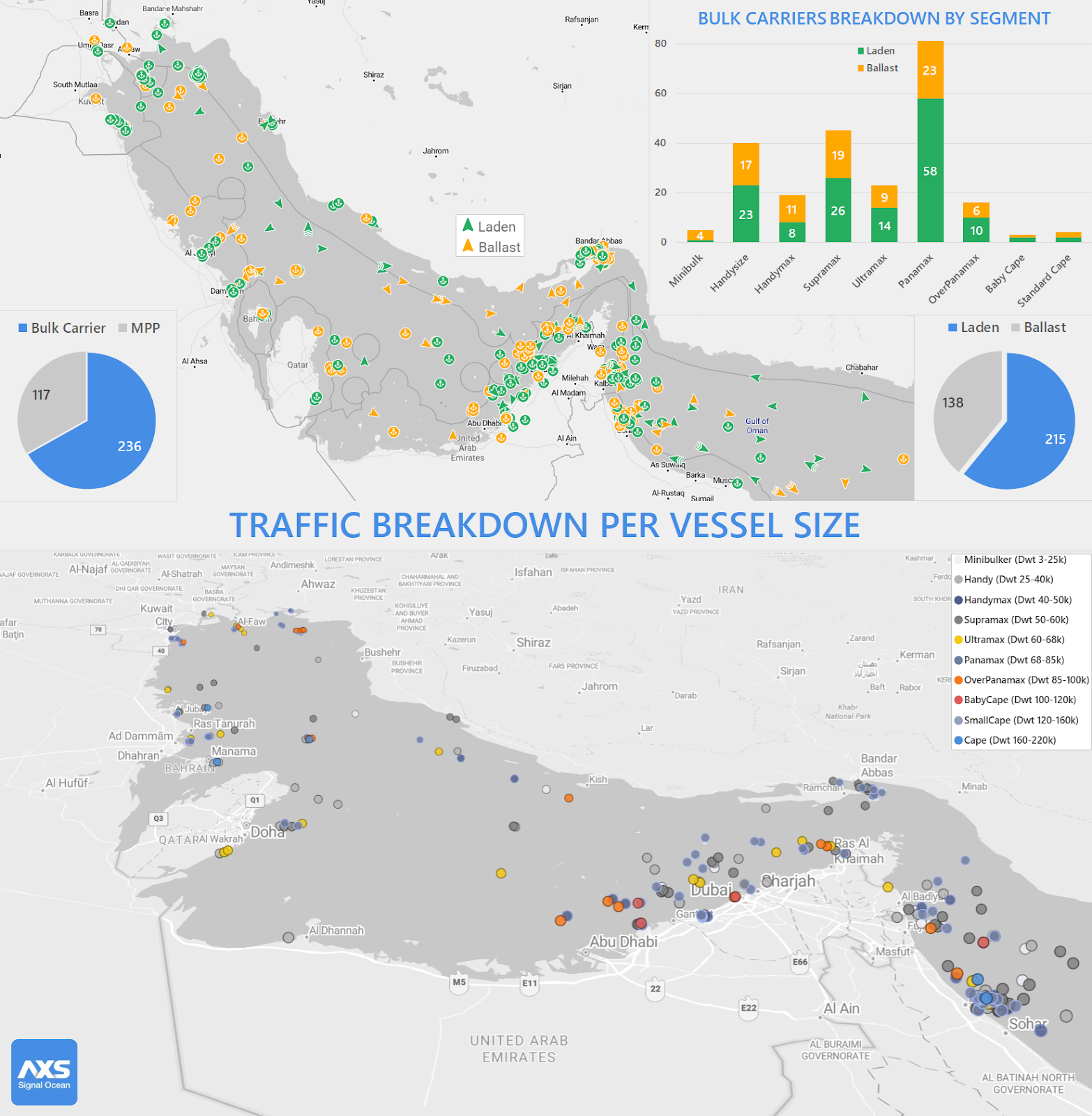
When the Gulf Went Still - AXSMarine & Signal OceanОn 28 February 2026, the Persian Gulf was running a normal book of business. Panamaxes were completing grain discharges at Bandar Imam Khomeini. Supramaxes were working fertilizer parcels. Handysizers were loading industrial minerals for Southeast Asian ports. Then the United States and Israel launched coordinated strikes on Iran — including the killing of Supreme Leader Ali Khamenei — and within seventy-two hours, the Islamic Revolutionary Guard Corps had formally declared the Strait of Hormuz closed. Only four vessels had crossed in either direction. The month that followed was unlike anything the dry bulk market had seen. Iran's IRGC transmitted warnings via VHF radio to vessels in the Strait, stating that no ship was permitted to pass. By 4 March, IRGC officials claimed "complete control" of the waterway. The self-imposed closure that followed was not the result of physical obstruction alone — it was the result of commercial operators making a rational calculation that the risk of transit outweighed any freight premium. This review draws on AXSMarine's AIS-derived tracking data, collected continuously throughout March, to document what that calculation meant for the dry bulk fleet: how many vessels were trapped, what cargoes they were carrying, how the flow of transits evolved, and what the data tells us about a market that never fully stopped — but came closer to it than at any point in recent memory. The FreezeIn early March, AXSMarine had identified 353 dry bulk and multipurpose vessels inside the Gulf — 236 bulk carriers and 117 MPPs. Of those, 144 bulk carriers and 71 MPPs were laden: cargo on board, nowhere to go. The remainder were ballasting, caught mid-reposition at exactly the wrong moment. To understand why this number matters, it helps to know what normal looks like. In the months preceding the conflict, between 20 and 30 dry bulk vessels crossed the Strait of Hormuz per month — a modest but economically significant flow underpinning grain, fertilizer, and industrial mineral supply chains between the Gulf and Asia. That flow had not slowed. It had stopped. Over the following two weeks, as the broader situation failed to normalise, the total fleet of all vessel types west of Hormuz continued to grow. By 9 March it had reached 1,061 vessels. By 12 March, 1,062 — the peak recorded during the month. The Gulf had effectively become a holding area for a substantial fraction of global merchant shipping. The size pictureThe trapped dry bulk fleet was not concentrated at one end of the size spectrum. Panamaxes (68–85K dwt) and Supramaxes (50–60K dwt) accounted for the largest shares, reflecting their role as the primary workhorses of Gulf commodity trades. Handysizes (25–40K dwt) were also well represented. At the upper end, four standard Capesize bulkers in the 170–180K dwt range were among the largest vessels present — a reminder that the Gulf does attract larger tonnage for bauxite, limestone, and bulk mineral exports, even if it is not a traditional Capesize routing.
What Was Locked InsideVessel counts give a sense of scale. Cargo volumes tell the supply chain story. AXSMarine's mid-March commodity analysis translated the trapped dry bulk fleet into tonnage terms — and the picture it produced was of a disruption hitting several import markets at once.
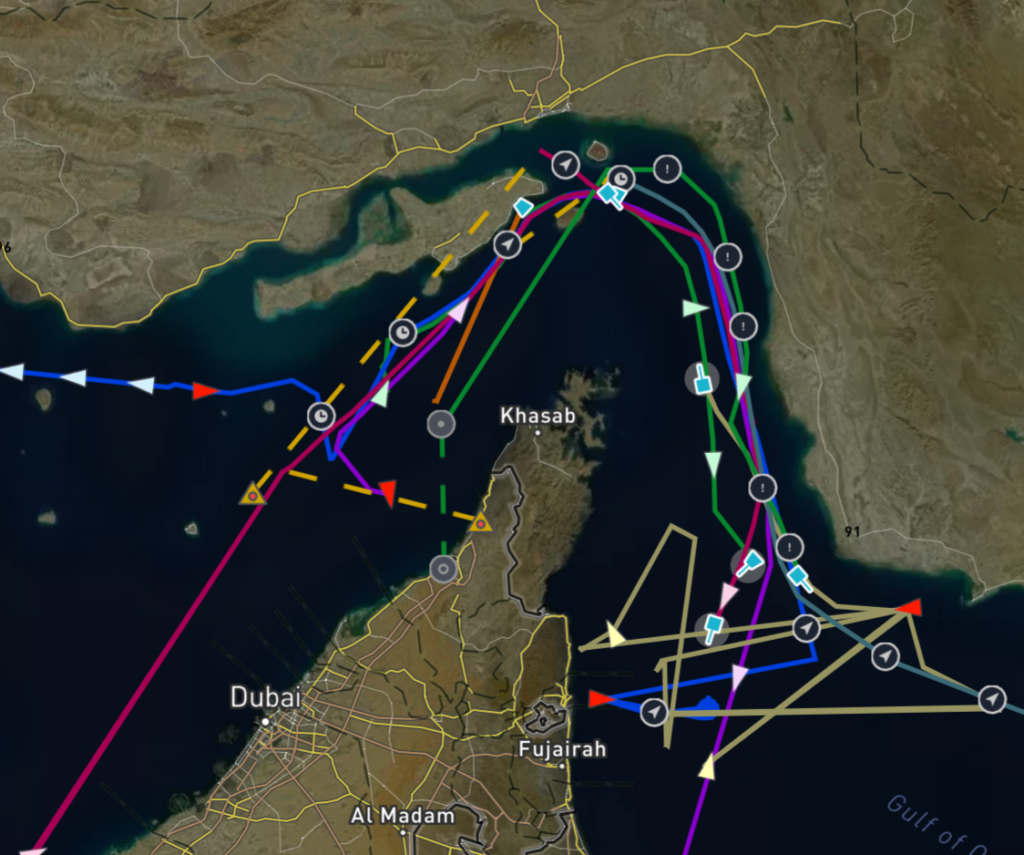
Strait of Hormuz Transits Steady - WindwardInbound traffic on April 7 comprised four sanctioned, Iranian-trading tankers only, reflecting uncertainty entering the Gulf amid U.S. threats to escalate attacks on Iran ahead of the eventual ceasefire announcement. Four of the outbound vessels were bulk carriers, a regular feature of limited transits with all previously calling at Iran. All vessels used the Northern Corridor, in place since mid-March that redirects traffic through Iranian waters and hugs the coastline instead of using the normal international channel. A southern corridor which hugs Oman’s coastline that was used by several ships last week has not seen any further visible traffic via AIS.
CEASEFIRE DECLARED — STRAIT REMAINS EFFECTIVELY CLOSED Hormuz traffic is unchanged in risk profile and numbers transiting since the ceasefire announcement. Five bulk carriers were tracked outbound as of 12:00 on April 8, and all appeared to be confined to the Iran Revolutionary Guards Corps-controlled corridor. Transit conditions, toll arrangements, and the legal framework for passage remain undefined. The strait has not reopened — it is in a supervised pause. Iran will demand shipping companies pay tolls, Hamid Hosseini, a spokesperson for Iran’s Oil, Gas and Petrochemical Products Exporters’ Union told the Financial Times. Fees would be paid in cryptocurrency with tariff of $1 for each barrel of oil with inbound transits at no cost, he said. Iran would require ship inspection and require approval. Radio broadcasts to tankers in the Gulf on Wednesday from Iran warned those transiting without approval would be struck. At best, a humanitarian corridor similar to the United Nation’s Black Sea grain corridor negotiated with Russia to let grain shipments leave Ukraine can be deployed. Mixed messages are emerging: Oman has said that it won’t pay any tolls and diplomatic engagement with Iran’s government appears key.
US Import Bookings Q1 2026: Navigating Uncertainty in a Front-Loaded Market - VizionQ1 2026 opened with a striking surge of pre-tariff front-loading, then softened sharply as shippers absorbed elevated import levels and uncertainty clouded the outlook. This report breaks down weekly booking trends, port performance, commodity flows, and carrier share shifts — giving you the data to make faster, smarter decisions.
Weekly booking trends: the front-load surge and the pullbackThe story of Q1 2026 is two acts. Weeks 1–4 saw robust volumes as importers rushed to beat anticipated tariff increases, with Week 3 topping 368K TEU — slightly above the same period in 2025. From Week 5 onward, bookings softened considerably, with Week 8 collapsing to just 154,730 TEU — the sharpest single-week dip in the dataset due to Chinese New Yea. By Week 13, volumes were recovering toward 352K TEU, signaling a floor may have been found.
Week 8 2026 (154,730 TEU) was 56.9% below the same week in 2025 (359,491 TEU) — a dramatic pullback likely driven by front-loading fatigue and the Chinese New Year holiday convergence. It stands as the weakest comparable week across all three years in this dataset. Port performance: winners and losers in Q1 2026The port picture is nuanced. Houston surged +17.1% year-over-year, emerging as the standout growth story of Q1. LAX held its top position despite a modest decline. Meanwhile, several major East and Gulf Coast ports saw meaningful volume erosion — particularly Savannah (−7.1%), Long Beach (−12.4%), and Seattle (−22.2%), which posted the steepest relative decline among major ports.
Houston's 17.1% YoY gain to 464K TEU suggests significant trade lane diversion — possibly from West Coast ports facing labor uncertainty and from importers diversifying port risk. Tianjin-linked flows into USTIW dropped 44.6%, the largest proportional decline of any port in the dataset.
How we can help:
Thank you for your time. Regards, James Littlejohn Co-Founder Info@maritimedata.ai +44 (0)208 050 9806 You might be receiving this email because we believe that the content of our newsletter may be of interest to you based on your profession. However, if we have made an incorrect assumption, we apologise for any inconvenience caused. If you do not wish to receive future publications, please follow the instructions below to unsubscribe. |



Maritime Data Newsletter
A dedicated source of market insights and product developments from the largest network of specialised providers of maritime data and analytics.
Maritimedata.ai is a single source of access to 200+ data services. 200+ Products 60+ Source data partners 30+ Years of Experience Explore our catalogue Insights 📈 Oil & Gas 🛢️ Structural Checkmate (Link) Strait Tensions Redirect North American Crude Flows (Link) Another Brick In The Wall - Houthi attacks complicate Saudi exports (Link) Dry 🚢 Q2 2026 saw strong growth in soybean and corn flows driven by a record Brazilian harvest (Link) Freight Outlook - 24/07 (Link) China unveiled a...
Maritimedata.ai is a single source of access to 200+ data services. 200+ Products 60+ Maritime Intelligence Providers 30+ Years of Experience Explore our catalogue Insights 📈 Oil & Gas 🛢️ How much of China's crude demand will return? (Link) "El Niño" Declaration Pressures US Crude Export Outlook (Link) Why China’s Crude Collapse Isn’t The Demand Story It Looks Like (Link) Dry 🚢 Q2 Sees Global Met and Thermal Coal Flows Accelerate (Link) Freight Outlook - 10/07 (Link) Frances Maize Crop Drops...
Maritimedata.ai is a single source of access to 200+ data services. 200+ Products 60+ Maritime Intelligence Providers 30+ Years of Experience Explore our catalogue Insights 📈 Oil & Gas 🛢️ Trumping 2025 (Link) Jones Act Vessels For International Crude Trade (Link) Full Steam Ahead? Not So Fast! (Link) Dry 🚢 Iron Ore Surplus Builds as Chinese Steel Margins Remain Under Pressure (Link) Weekly Grains & Oilseeds Outlook -26/06 (Link) China’s coal imports in May fell 8% year-on-year (Link) Other 🌎...